
The rise of connected TV creators is one of the most consequential — and least discussed — shifts in the creator economy. For more than a decade, “creator content” has been effectively synonymous with the phone: short, vertical, thumb-scrolled, watched in transit or in bed. That association ran so deep that most creators never questioned it. The phone was simply where creator video lived.
In 2026, that assumption is breaking. Connected TV (CTV) — the living-room television, reached through streaming devices and smart-TV apps — is becoming a primary destination for creator content, not just professional studio streaming. The biggest screen in the house is opening up to the same creators who built their audiences on the smallest one. And for the creators who understand this early, it points at the most valuable screen they have never used.
This guide explains what is actually driving the shift, why the television is structurally more valuable than the phone in a watch-time economy, and what connected TV creators can do to capture a screen most of their peers are still ignoring.
Creator Video Grew Up on the Phone
The phone shaped a decade of creator content — not because it was the best screen, but because it was the only one creators could reach. Distribution was built around mobile apps, discovery was tuned for the vertical feed, and the formats that won were the ones that worked in a few square inches held at arm's length.
That produced extraordinary creativity within a narrow frame. But it also trained an entire generation of creators to think small — literally. Content was designed for a glance, optimised for the scroll, and measured by how many people tapped rather than how long they stayed. The phone was the medium, and the medium set the ceiling.
The television, meanwhile, stayed reserved for a different class of content: films, series, live sport, and the professionally produced catalogues of the major streamers. The living room was where you watched things made by studios. The phone was where you watched things made by people. That division has quietly held for the entire history of the creator economy — and it is exactly what is now coming apart.
Why the Television Is the Most Valuable Screen
To understand why this matters, you have to look past the size of the screen to the quality of the attention it commands.
The television has always been the most immersive screen in the home. It is watched deliberately, from a seated position, usually with sound on and full attention given. There is no adjacent feed to scroll to, no notification pulling the eye away, no thumb hovering to swipe. A viewer who puts something on the living-room television has, in effect, committed to watching it — and that commitment tends to be worth more to everyone in the chain.
It tends to be worth more to advertisers, who typically pay higher rates to reach audiences on the television than on mobile, precisely because the attention is deeper and less interrupted. And in a creator economy that increasingly measures and rewards genuine watch time, that deeper attention flows back to the creator.
The phone captures glances. The television captures attention. In an economy that is learning to reward attention over clicks, that difference is the whole story.
This is the crucial link. As creator platforms move from rewarding raw views to rewarding real watch time, the screen that generates the longest, most attentive viewing sessions becomes the most valuable place a creator can be. For years that screen was closed to creators. Now it is opening.
What Actually Changed: Access, Not Appetite
The appetite for creator content on the television was never the missing piece. Audiences have wanted to watch creators on the big screen for years — anyone who has cast a video from their phone to the living-room TV already understands the appeal. What was missing was native access.
That is what has changed. Creator platforms are now natively available across the major connected TV platforms — Apple TV, Roku, Android TV, Amazon Fire TV, Samsung TV, and LG TV. A creator who publishes once can now be discovered and watched directly on the television, through a proper app on the biggest screen in the house, with no casting, no workarounds, and no separate upload.
That single change rewrites the distribution map. For the first time, the same piece of content a creator makes can reach a viewer scrolling on their phone during a commute and a viewer settling onto the sofa in the evening — from one upload, with no extra work. The creator does not choose between screens. They reach all of them.
Why Connected TV and Watch-Time Economics Compound
The reason connected TV is not just another screen — but a genuinely more valuable one — comes down to how CTV viewing behaves compared with mobile.
Connected TV sessions tend to be longer, more attentive, and less fragmented than mobile sessions. People lean back and watch, rather than lean in and scroll. That has direct consequences in a watch-time model, where a creator's earnings track how long people genuinely watch rather than how many times a video is clicked.
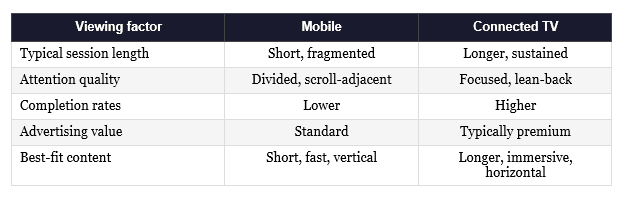
Read down that table and the compounding effect becomes clear. Longer sessions and higher completion rates mean more monetized watch time per viewer. Premium advertising value means that watch time tends to carry more value. Put those together and a single view on the television can be worth considerably more to a creator than the same view on a phone — not because the content changed, but because the screen, and the attention it commands, did.
For connected TV creators, this is the structural insight: the television is the one screen where deeper attention and higher value line up in the same place. In a watch-time economy, that alignment is exactly what a creator wants to be pointed at.
What This Means for Connected TV Creators
The opportunity is real, but capturing it takes a small shift in how you think about the content you make. A few practical adjustments help:
Make content that rewards a longer sit.
The phone rewards the fast hook and the quick payoff. The television rewards content people settle into — tutorials, commentary, music, storytelling, and longer-form pieces that hold attention across minutes rather than seconds. If your content already holds attention, the television is where that strength pays off most.
Think horizontal, and think about the room.
Content built for the big screen reads differently: wider framing, cleaner audio, and pacing designed for a viewer who is watching rather than scrolling. You do not need a studio — authenticity still wins — but you do need to remember your video may be playing ten feet away, not ten inches.
Prioritise completion over clicks.
Because connected TV viewing is measured by sustained attention, the metric that matters is how much of your video people actually watch. Content designed to be finished, not just started, is what compounds on the television.
Publish where one upload reaches every screen.
The connected TV opportunity only works if your content is actually on the television. Publishing on a platform with native presence across the major CTV platforms means a single upload reaches the living room automatically — instead of leaving the biggest screen out of your distribution entirely.
How LYKSTAGE Puts Creators on Every Screen
LYKSTAGE was built around exactly this multi-screen reality. When a creator publishes on LYKSTAGE, their content is available across mobile, web, and six connected TV platforms — Apple TV, Roku, Android TV, Amazon Fire TV, Samsung TV, and LG TV — from a single upload. There is no separate workflow for the television and no additional effort to reach the living-room screen. One publish, every screen.
That reach sits on top of a watch-time value model designed to recognise exactly the kind of attention the television commands. Because the model rewards genuine watch time rather than raw view counts, the longer, more attentive sessions that connected TV generates are recognised for what they are — and a creator's share of that monetized watch time starts at 45% and rises automatically to 70% as their content reaches more unique viewers, across every screen and market.
And because LYKSTAGE has no subscriber threshold, this multi-screen reach is available from a creator's very first video. A new creator does not have to build a mobile following before unlocking the television — they are on every screen from day one.
For connected TV creators, that is the whole proposition in one line: make your video once, and reach the phone, the laptop, and the biggest screen in the house — on a platform built to recognise the attention each of them earns.
The Bottom Line
For a decade, the creator economy was a phone economy — small screens, quick glances, and content measured by clicks. In 2026, that is changing. Connected TV is opening the biggest, most immersive, most valuable screen in the home to the same creators who built their audiences on the smallest one. And in an economy that increasingly rewards genuine watch time, the television is where deeper attention and higher value finally meet.
The connected TV creators who understand this early — who make content that rewards a longer sit, and publish where one upload reaches every screen — will capture a screen most of their peers are still ignoring. The living room is no longer reserved for the studios. It is open to creators. The only question is whether your content is on it.
To go deeper on the shifts behind this one, explore our complete guides:
→ The Complete Guide to Watch-Time Monetization
→ Video Creator Platforms Compared: The Complete 2026 Guide
Ready to reach every screen from a single upload? Start building your audience on LYKSTAGE — from mobile to the living-room television, create your channel at www.lykstage.com. Real attention. Real value. For everyone.