
.jpeg&w=3840&q=75)
For years, the creator economy has measured success in one currency: views. Every analytics dashboard leads with them. Every sponsor asks for them. Every creator chases them. But when it comes to actual creator earnings in 2026, the watch time vs views debate has a clear winner — and most of the industry is only just catching up.
Views tell you how many people clicked. That is it. They do not tell you whether those people watched for 3 seconds or 3 minutes. They do not tell you whether your content delivered on its thumbnail's promise. And most critically, they do not correspond to how much a creator actually earns. Watch time does.
A Tale of Two Creators
Consider two creators publishing on the same video platform this month:
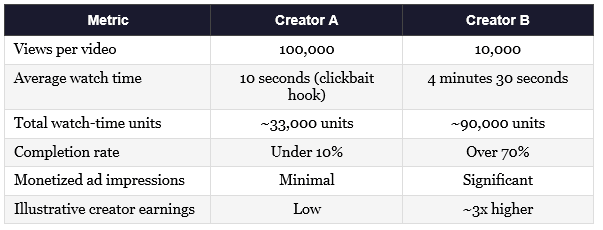
Creator A publishes a flashy, clickbait-style thumbnail that pulls in 100,000 clicks. Average watch time: 10 seconds. Most viewers realised they had been baited and bounced. The view count looks impressive. The earnings do not.
Creator B publishes a longer, substantive video that attracts 10,000 views. But those viewers stay — average watch time of 4 minutes 30 seconds, completion rate above 70%. They return, they subscribe, they share.
Creator B generated roughly three times more monetizable watch time than Creator A with one-tenth the view count. On a watch-time-based platform, Creator B earns significantly more. On a views-based platform, Creator B would appear to be losing.
This is the central problem with views as a metric. They reward how well a creator captures attention — not how well they hold it. And in an industry where advertisers pay for held attention, that gap between capture and hold is the gap between a creator's earnings and a creator's illusion of success.
Watch Time vs Views: The Head-to-Head
Here is how the two metrics actually compare across the dimensions that matter for creator earnings:
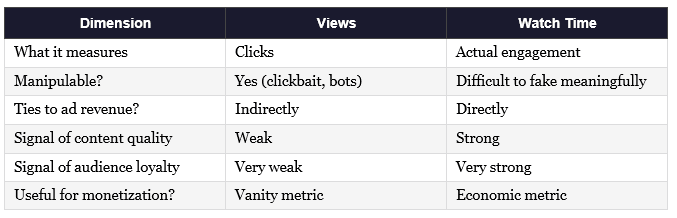
Views can be inflated through clickbait, autoplay loops, and — on some platforms — bot traffic. Watch time cannot. A video cannot accumulate meaningful watch time without actual humans actually watching. That is why advertisers increasingly value watch time as the cleaner, more verifiable signal of attention, and why the best content sharing platforms have started compensating creators based on it.
How LYKSTAGE Makes Watch Time the Metric That Pays
LYKSTAGE is built entirely around watch time as the foundational economic unit. Every uninterrupted 30 seconds a logged-in viewer spends watching monetized content equals one Watch-Time Unit. Those units are what translate into creator earnings — not clicks, not impressions, not arbitrary view counts.
The 30-second unit is deliberate. It is long enough to represent genuine engagement — not an accidental scroll-past — but short enough to capture the reality of how people watch video in 2026, where session lengths are shorter and content variety is wider. A 3-minute video that holds a viewer for its full duration generates 6 Watch-Time Units. A 10-minute video held to completion generates 20. A viewer who bounces after 15 seconds generates zero.
This architecture has three downstream effects that matter for creators:
1. Creator earnings track audience engagement directly. There is no lag between the quality of your audience relationship and the size of your earnings. When your watch time grows, your earnings grow.
2. Content quality is structurally rewarded. Creators who produce genuinely engaging content accumulate watch-time units faster than creators who rely on misleading thumbnails. The model closes the gap between quality and compensation.
3. Earnings are transparent. Because every 30-second unit is a discrete, trackable object, creators can see exactly which videos generate which proportion of their earnings — not a black-box algorithm distributing revenue by opaque rules.
On most video platforms, you are paid roughly based on views — with completion rate as a faint secondary signal. On LYKSTAGE, you are paid based on watch-time units. That is not an incremental change. That is a different economic model.
What This Means If You Are a Creator
If you publish on a platform that pays based on watch time, three practical things change about how you should build content:
Thumbnails still matter — but they matter for bringing the right viewer in, not just any viewer. A thumbnail that over-promises creates bounce, which destroys your watch-time units. A thumbnail that accurately represents the content attracts viewers who stay.
Length becomes strategic. Longer videos with high completion rates generate significantly more watch-time units than short videos with the same completion rate. If your content can genuinely hold attention for 8 minutes, it will earn more than the same content compressed into 3.
Community building compounds faster. Viewers who return to your channel have higher baseline engagement, which means every piece of content you publish starts with a more loyal audience. On a watch-time model, this translates directly into more earnings per upload.
→ Deep dive: The Complete Guide to Watch-Time Monetization for Video Creators
The Metric That Actually Matters
Views will always be a useful top-of-funnel metric. They signal discoverability and reach. They look good on dashboards and in pitch decks. But when the question is what a creator actually earns, views are an indirect, increasingly unreliable proxy for the only number that matters: how much time real viewers spent with your content.
Watch time is the metric that aligns with creator earnings. It is the metric advertisers value. It is the metric that cannot be gamed without actually doing the work. In the watch time vs views debate of 2026, the honest answer is that they are not equivalent — and the creators who build around the metric that actually pays will earn significantly more than the creators who keep chasing the one that does not.
Stop optimising for views that do not pay. Start building on LYKSTAGE — the video platform where watch time is what earns. Real attention. Real value. For everyone.