
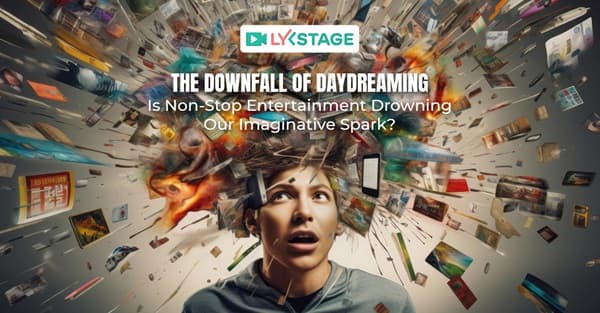
Is Non‑Stop Entertainment Drowning Our Imaginative Spark?
With the video sharing platform, our screens provide us with an unending feed of curated content, whether in the form of short-form clips or binge-worthy series. Though amusing, this continuous stimulation begs a serious question: Is unceasing consumption being a kill-joy to our power of daydreaming, and, consequently, to our creative imagination?
Introduction
1. The Secret of Daydreaming
Positive constructive daydreaming (PCD) has been shown to have cognitive advantages, and is far from being a passive distraction. It is associated with improved planning, increased reflection, creativity, and even improved brain organization—driven by the default mode network (DMN).
Research has found that almost half of our time when awake is devoted to daydreaming. It is in this state of reflection that we develop empathy, moral reasoning, and innovative thinking—traits that are important not only in our personal development but also in societal development.
2. Non-Stop Entertainment and Cognitive Costs
The “Popcorn Brain” Effect
This continuous digital multitasking leads to the development of popcorn brain, in which users are overstimulated and incapable of performing slower tasks. It is especially associated with reduced attention span, emotional control and verbal IQ in teens.
Memory & Context Switching
The constant use of video sharing platforms such as TikTok or YouTube results in impaired prospective memory—we forget what we wanted to do—because of the quick-context switching of unrelated material.
Multitasking
This divided attention lowers working memory and creativity. It also heightens decision-making biases, stress, and burnout because the brain is constantly processing inputs without intensive processing.
3. The Problem of Screens Killing Imagination
Passive vs. Active Thinking
Passive screen time (e.g., binge-watching or scrolling) provides ready-made images, and thus there is less need to engage in imagery. Studies indicate that this results in a cognitively poor experience in contrast to real-world learning or interactive learning.
Tediousness Is the Nursery
Imagination requires boredom. We deprive ourselves of the opportunity to think, speculate, or invent when we remove moments of silence and idleness by being entertained all the time.
Early Development Risks
In young children, screen time has been associated with disturbed brain development, affecting attention, language, and social skills. Screen storytelling has little of the immersion that reading or pretend play has, which makes it less creative
4. When Screens Can Spark Creativity
Not everything on the Internet is unimaginative. Creative apps or open-world games can also improve imagination when used wisely and on a video sharing platform that encourages active engagement.
Young children also gain when screen time is cooperative or self-directed, but not imposed or over-programmed by adults. The most important thing is how and why the screen is used, not how much.
5. Finding the Lost Imaginative Spark
White Space Your Day
Let silence in. A music-free walk, a line-free wait—the mind wanders with these simple things.
Re-brand Daydreaming as Productive
Stillness can be confused with laziness in a society where people are obsessed with hustle. But numerous discoveries—inventions, as well as art—started in silent seclusion. Educating children and adults to appreciate the time off is essential to creativity.
Be Purposeful With Digital Use
The algorithms used in most video sharing platforms are developed with stickiness, not serenity, in mind. However, platforms such as LYKSTAGE are transforming the script—focusing on mindful content discovery, transparency, and user choice.
By focusing on quality rather than quantity, LYKSTAGE honors the attention span of the user, contributing to a more healthy balance between stimulation and space to think.
Cognitive overload can be minimized through intentional choices, such as utilizing a video sharing platform that prioritizes focus over addiction and helps imagination.
Conclusion
Although information on a video sharing platform may be entertaining and informative, its omnipresence may gradually strip us of our ability to daydream—the creative power of our mind, our ability to think empathically and meaningfully.
We must tolerate boredom, edit our digital lives, and set aside enough time to think profoundly and without interruption to maintain our creative fire. Such platforms as LYKSTAGE provide an alternative to algorithm-based overload—a platform that respects the mind and its need to reflect as much as it is to entertain.
The best ideas, because we do not watch them sometimes, but walk in wanderings.