
.jpeg&w=3840&q=75)
Search for video platforms that pay creators and you will find no shortage of options — but “pays creators” can mean wildly different things from one platform to the next. On some, you can start the moment you upload. On others, you will work unpaid for months, cross a subscriber gate, and only then share in a fraction of the advertising revenue your videos generate. The headline “we pay creators” hides most of what actually matters.
This guide cuts through it. We break down how the major video platforms that pay creators actually work in 2026 — what it takes to qualify, what they pay on, how much creators keep, and where the money itself comes from — then give you a simple way to choose the one that fits what you make. Programs and figures change often, so treat the specifics below as a 2026 snapshot and confirm current terms before you commit.
What “Paying Creators” Actually Means
Before comparing platforms, it helps to know what to compare. Five factors separate a platform that genuinely rewards creators from one that simply advertises that it does:
1. Time to first payout.
The single biggest difference. Some platforms let you start from your first upload; others require a subscriber or follower threshold — often months of unpaid work — before you can share in anything.
2. What it pays on.
Views, watch time, or engagement? A platform that pays on genuine watch time rewards content people actually watch; one that pays on raw views rewards the click. The metric shapes what kind of content wins.
3. The creator's share.
Once you qualify, how much of the value your content generates do you keep? Shares vary widely — and some “funds” are not a share of revenue at all, but a fixed pool divided among everyone.
4. Who else gets rewarded.
On almost every platform, the viewer — whose attention funds the whole system — receives nothing. A small number of newer platforms share value with viewers too, which changes how loyal an early audience becomes.
5. Where the money comes from.
Almost nobody asks this one, and it predicts more than the rest. Is your payout a share of revenue your own work generated — or a pool carved out of a marketing budget? The first is structurally durable: the more people genuinely watch, the more there is to share. The second lasts exactly as long as someone chooses to keep funding it, which is why creator funds have a habit of being capped, restructured, or quietly closed once they have done their job of attracting creators.
The question to ask any payout model isn't how generous it looks. It's where the money comes from.
Keep those five in mind as we go through the platforms.
The Video Platforms That Pay Creators in 2026
YouTube
Still the biggest, and for established creators, among the most rewarding. Through the YouTube Partner Program, creators keep roughly 55% of the advertising revenue their long-form videos generate. The catch is the gate: full ad-revenue sharing requires 1,000 subscribers plus 4,000 valid public watch hours in a year (or 10 million Shorts views in 90 days). A lower tier unlocks fan-funding features like memberships and Super Thanks at 500 subscribers — but not ad-revenue sharing. For a beginner, that can mean many months before the first share of ad revenue.
TikTok
TikTok's Creator Rewards Program replaced the old Creator Fund and pays considerably better than its predecessor — but it is built for scale. To qualify you need at least 10,000 followers and 100,000 video views in the previous 30 days, and only original videos longer than one minute count. Payouts run on an RPM of roughly $0.40 to $1.20 per thousand qualified views, higher in niches like finance and technology. It rewards reach and retention, but the follower gate keeps most new creators out for a while.
Facebook and Instagram (Meta)
Meta pays creators across Facebook and Instagram largely through performance bonuses and in-stream and Reels ad sharing, at very significant scale. The complication is access: much of Meta's direct creator pay is invitation-based and variable, without a single clean public threshold you can simply work toward. Brand partnerships remain the dominant income source for creators here, with platform payouts a supplement. Excellent if you are invited; unpredictable if you are not.
LYKSTAGE
LYKSTAGE takes the opposite approach to the threshold. There is no subscriber or follower minimum at all — creators share in monetized watch time from their very first video, the moment it builds traction. Watch time accumulates while someone is genuinely watching and engaged, and becomes monetized when the ad served during that viewing is watched in full, which is the moment real advertising revenue exists to share.
The creator is allocated first, with a share that starts at 45% and rises automatically to 70% as a video reaches more unique viewers. Logged-in viewers are then rewarded from the remaining balance, in LYK Coins that carry a real US dollar value — as an example, around 50 LYK Coins is approximately US $1, with current rates always shown in the app. The viewer's reward never reduces the creator's share. A single upload reaches mobile, web, and six Connected TV platforms across five markets, and the model itself is protected by U.S. Patent No. 12,684,189.
Also worth knowing
Beyond the big feeds, streaming-first platforms like Twitch pay through subscriptions, ads, and viewer tips, and a handful of alternative video platforms compete on higher revenue shares. These are worth a look depending on whether you stream live or publish on-demand — but most carry their own eligibility gates.
At a Glance: How the Platforms Compare
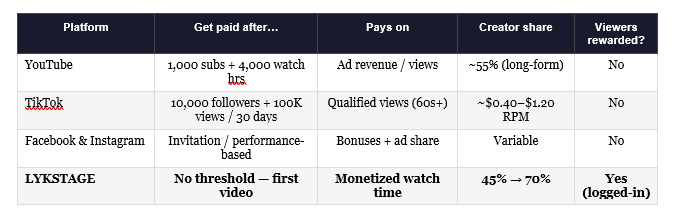
Figures are a 2026 snapshot; platform terms change frequently — confirm current requirements before choosing.
Which Platform Should You Choose?
There is no single best platform — only the best fit for what you make and where you are in your journey.
If you are established, with a large existing audience, YouTube's ad-revenue share and TikTok's reach are hard to ignore. If brand deals are your main game, Meta's scale and creator marketplace matter. But if you are starting out — or you make long-form content people genuinely watch, or you want your early audience to have a reason to stick around — a no-threshold, watch-time platform like LYKSTAGE removes the single biggest reason beginners quit: working for months before anything counts.
The bigger a platform's audience, the steeper its gate tends to be. The real question is whether you can afford to wait to get through it.
Why LYKSTAGE Pays Creators From Day One
Most of the friction in “getting paid” as a creator comes down to one thing: the wait. LYKSTAGE was built to remove it.
No threshold.
You share in monetized watch time from your first video — no subscriber gate, no watch-hour minimum, no waiting period.
Paid on genuine watch time.
Your share tracks how long people actually watch, not how many times they click — which rewards content that holds attention. Watch time accumulates while a viewer is engaged, and monetizes when the ad served is watched in full.
A share that grows with you.
Your share starts at 45% and rises automatically to 70% as your content reaches more unique viewers. No renegotiation, no application — it moves as your reach does.
Viewers share too.
Logged-in viewers receive a share of monetized watch time in LYK Coins with real US dollar value — so your early audience has a genuine reason to watch fully and return. Creators are allocated first; viewer rewards come from the remaining balance and never reduce the creator's share.
Funded by revenue, not subsidy.
Every reward is a share of the advertising revenue the watching itself created — not a fund carved out of a marketing budget, not a token, and not an investor subsidy timed to run out. There is nothing to switch off.
Every screen, one upload.
Your content reaches mobile, web, and six Connected TV platforms — Apple TV, Roku, Android TV / Google TV, Amazon Fire TV, Samsung TV, and LG TV — across five markets, from a single upload.
A protected model, at real scale.
The architecture is protected by U.S. Patent No. 12,684,189, granted in July 2026. More than a million people have experienced LYKSTAGE, over 20,000 creator channels are on the platform, and advertising is live across all five markets.
For a creator who wants the earnings clock to start on day one — when motivation matters most — that combination is hard to match.
The Bottom Line
The best video platform that pays creators in 2026 is not a single answer — it is the one whose thresholds, metric, share, and funding source fit what you make and how far along you are. The dominant platforms pay well but gate hard: you wait, then share in a slice of ad revenue once you are through. The newer watch-time model flips that — pay from day one, on genuine attention, with a share that grows as you do, funded by real advertising revenue, and, on LYKSTAGE, value shared with viewers too.
Whatever you choose, judge it by the five things that actually matter: how soon you can start, what it pays on, how much you keep, who else it rewards, and where the money comes from. The platform that scores best on those — for you — is the one worth building on.
To go deeper, explore our complete guides:
→ Video Creator Platforms Compared: The Complete 2026 Guide
→ The Complete Guide to Watch-Time Monetization
→ Best Video Platform for Beginners in 2026: How to Choose
Want the earnings clock to start on day one? Build your audience on LYKSTAGE and share in monetized watch time from your very first video — create your channel at www.lykstage.com. Real attention. Real value. For everyone.