
.jpeg&w=3840&q=75)
Then the payout arrives—and barely moves.
Nothing necessarily failed. The creator may have optimized the metric that helps content travel, not the conditions that allow attention to generate revenue.
That distinction is the answer to a question almost every serious creator eventually asks: What drives creator earnings—watch time or engagement?
The honest answer is more precise than either one.
Engagement can expand distribution. Watch time reveals whether attention held. Earnings depend on how much of that attention becomes eligible, monetized viewing—and on the revenue rate, platform share and eligibility rules applied to it.
A like can help a video reach another viewer. A comment can signal relevance. A share can introduce the creator to a new audience. But none of those actions automatically means an advertisement was served, watched or converted into revenue.
That is why visibility and earnings can move in different directions.
Watch Time and Engagement Do Different Jobs
Engagement and watch time are often grouped together as “performance,” but they answer different questions.
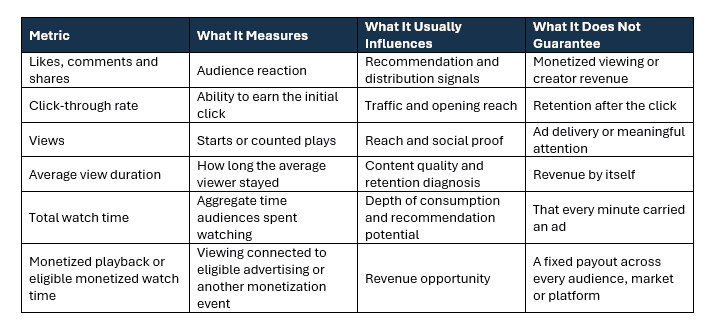
Official YouTube documentation makes the distinction explicit: total views, ad impressions and estimated monetized playbacks are different metrics, and not every video view contains an advertisement. Ad availability can depend on advertiser demand, audience targeting, geography, viewer history, content suitability and other factors.
In other words, attention creates the opportunity for revenue; monetization conditions determine whether that opportunity becomes earnings.
Why High Engagement Can Produce Disappointing Earnings
Creators often experience an earnings gap because engagement is immediate and visible while monetization is conditional and delayed.
A “view” is not the same as a monetized view
A large view count can contain a very wide range of audience behavior. One viewer may stay for several minutes. Another may leave almost immediately. A third may watch in a market with strong advertising demand, while a fourth may not receive an advertisement at all.
Counting all four as “views” is useful for measuring reach. It is not enough to explain revenue.
Engagement can be optimized without increasing attention
Comment prompts, polarizing hooks and deliberately incomplete claims can generate reactions. Some of those tactics may improve distribution, but if they frustrate viewers or delay the promised value, retention can fall.
The result is a dangerous dashboard illusion: the visible engagement metrics rise while meaningful consumption remains flat—or declines.
Format changes the economics
A short clip can generate a high number of reactions per minute of content. A longer video can generate fewer reactions but substantially more viewing time. Neither format is automatically superior; they serve different audience behaviors and monetization opportunities.
The creator’s mistake is not choosing short form or long form. It is judging both with the same metric.
A Better Model for Understanding Creator Revenue
For advertising-supported video, a useful conceptual model is:
Creator earnings = eligible monetized viewing × realized advertising value × creator revenue share
This is not a universal payout formula. Platforms calculate revenue differently, and creators may also earn through subscriptions, memberships, sponsorships, commerce or direct audience support. But the model exposes the variables that engagement dashboards often hide.
The Five Variables That Shape Creator Earnings
1. How much viewing is eligible to be monetized
The first question is not simply, “How many views did the video receive?” It is, “How much genuine viewing met the platform’s monetization conditions?”
On ad-supported platforms, not every view carries an ad. YouTube, for example, distinguishes between views and estimated monetized playbacks and explains that ad delivery can vary by content suitability, ad settings, targeting, geography and availability.
This is why raw views alone are an incomplete earnings metric.
2. Whether viewers stay long enough to create meaningful attention
Watch time is duration multiplied by retention. A ten-minute video that holds viewers for most of its runtime can create more meaningful attention than a much larger number of brief starts.
That does not mean every video should be longer. Padding a six-minute idea into twelve minutes can reduce average view duration and damage audience trust. The objective is not maximum length. It is maximum justified attention.
3. The value of the advertising served
Advertising value is not uniform. It can vary by country, audience, advertiser demand, content category, device, season and format. Two creators can generate similar viewing volume and receive different revenue outcomes because the monetized inventory around that viewing is valued differently.
This is one reason creators should examine revenue per thousand views or monetized playbacks alongside watch time rather than treating any single metric as the whole story.
4. The creator’s revenue share
Even when two platforms generate the same advertising revenue from comparable viewing, the creator outcome can differ because the platform’s allocation rules differ.
A creator should therefore ask three questions before deciding where to build:
1. What percentage of resulting revenue is allocated to the creator?
2. Does that share change as the creator’s audience grows?
3. Can the platform change eligibility or allocation without clear visibility?
The revenue share is not a secondary detail. It is one of the largest structural variables in creator earnings.
5. Whether a monetization gate exists
Some platforms require creators to meet subscriber, watch-hour, view, policy and review requirements before they can participate in monetization programs. YouTube’s Partner Program, for example, applies defined subscriber and viewing thresholds in addition to policy and account requirements.
These programs can be valuable, but the gate matters. A creator may produce genuine watch time before becoming eligible to receive a share of the revenue associated with it.
That is the crucial distinction between creating attention and being eligible to participate in its monetization.
Where Engagement Still Matters
Engagement is not irrelevant. It is simply not the same as earnings.
Likes, comments and shares can help content reach new viewers. New viewers can create more watch time. Strong watch time can create more monetization opportunities. The relationship is indirect but important:
Engagement can create distribution. Distribution can create watch time. Eligible monetized watch time can create revenue.
The mistake is treating the first step as if it were the final outcome.
A creator should therefore use engagement as a leading indicator of audience response, watch time and retention as measures of content depth, and monetized-playback or eligible-watch-time data as measures of revenue opportunity.
How LYKSTAGE Approaches Watch-Time Monetization
LYKSTAGE was designed around the idea that attention should be measured and shared more directly.
No subscriber threshold before creator participation
Creators can begin participating in watch-time monetization from their first video, without waiting to cross a subscriber or follower minimum. When a qualifying watch session becomes monetized, the creator can receive a share of the resulting advertising revenue.
This does not mean every view automatically produces revenue. Monetization remains dependent on qualifying viewing, completed advertising, ad availability, geography, content eligibility and applicable program terms.
The creator is allocated first
LYKSTAGE’s creator share begins at 45% of resulting advertising revenue and rises automatically to 70% as a video reaches more unique viewers. The creator allocation is calculated before eligible viewer rewards are distributed.
That sequence is central to the model: rewarding a viewer does not reduce the creator’s allocated share.
Eligible viewers can share in the value they help create
When an eligible logged-in viewer generates qualifying monetized watch time, the viewer may receive LYK Coins from the remaining balance after the creator allocation. LYK Coins carry a U.S. dollar value under the rates and terms shown within LYKSTAGE.
If the viewer is logged out, a qualifying watch session may still generate monetized watch time for the creator, but the viewer cannot receive a reward because there is no eligible account to credit.
The model is protected by a U.S. patent
LYKSTAGE’s Watch-Time Unit and reward-share architecture are protected by U.S. Patent No. 12,684,189, issued on July 14, 2026. The patent describes watch-time units and a revenue-sharing mechanism involving creators, logged-in viewers and the platform.
One upload can reach audiences across screens
LYKSTAGE is available through mobile, web and six Connected TV platforms: Apple TV, Roku, Android/Google TV, Amazon Fire TV, Samsung TV and LG TV. This matters for creators producing music videos, films, education, documentaries, interviews and other content designed to hold attention beyond a short mobile scroll.
What Creators Should Optimize Now
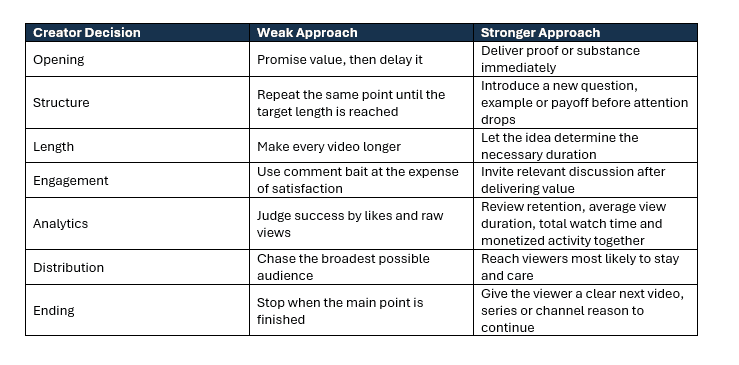
If attention—not reaction alone—creates monetization opportunity, content strategy should change accordingly.
Deliver the promise early
The opening should confirm that the title and thumbnail were honest. Viewers do not need the full answer in the first ten seconds, but they need evidence that the answer is coming.
Build for the middle
Many videos do not fail at the opening. They fail when the middle stops adding information. Review the retention curve and identify the point where the video begins repeating itself, slowing down or drifting away from the original promise.
Then redesign that moment.
Use length as a creative consequence, not a target
A complete three-minute idea is stronger than a padded eight-minute video. A compelling twenty-minute documentary is stronger than a rushed six-minute edit. The correct length is the shortest runtime that delivers the full value of the idea.
Separate reach metrics from revenue metrics
Do not ask one number to do every job. Use engagement to understand response, retention to understand content quality, watch time to understand depth, and monetization data to understand revenue.
The Bottom Line
Creators are not wrong to care about engagement. They are wrong only when they treat engagement as the same thing as monetization.
Engagement helps a video travel. Watch time shows whether attention held. Monetization rules determine whether that attention creates revenue—and how much of that value reaches the creator.
The most durable creator strategy is therefore not to chase the loudest reaction. It is to make work that earns the click, keeps the promise, holds attention and is published on platforms whose monetization rules are clear.
If you want to understand the model in greater depth, continue with:
· The Complete Guide to Watch-Time Monetization
· How to Grow a Video Channel in 2026
· Best Video Platforms That Pay Creators in 2026
Ready to build value from the attention your content earns? Create your LYKSTAGE channel and start publishing across mobile, web and Connected TV.
Monetization and viewer rewards are subject to qualifying watch sessions, completed advertising, ad availability, account eligibility, geography, current program rates and applicable terms. Earnings and rewards are not guaranteed.